Original: $16.95
-65%$16.95
$5.93The Story
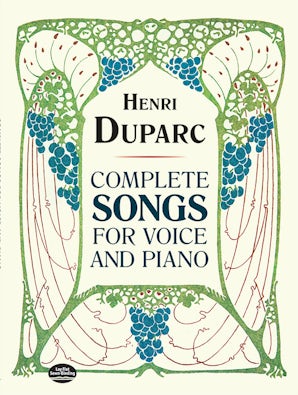
Henri Duparc (1848–1933) left a total of 17 songs, all written between 1868 and 1884 and most of them published in 1895. Besides the 13 songs in the collection published by Rouart, Lerolle & Cie. in 1911, Duparc composed four other vocal pieces including his only duet, "La fuite." He tried to destroy three of the youthful Cinq mélodies, Op. 2, published by G. Flaxland in 1870: "Sérénade," "Romance de Mignon," and "Le gallop." The composer succeeded only in considerably reducing the number of prints, to the point, however, where musicologists considered these melodies as lost. Their republication in the present edition is based on three of the rare remaining copies of the 1870 publication (the songs were issued individually).
Three items merit comments in passing:
"Au pays ou se fait la guerre," under its original title "Absence," was originally intended for Roussalka, an opera destroyed by Duparc.
It is not clear who wrote the poem "Chanson triste." Henri Cazalis's name appears in the Flaxland edition (1870), but Jean Lahor is credited as poet in Rouart's "Nouvelle édition complète" (1911).
Although the translator of Thomas Moore's "Oh! Breathe Not His Name," using the title "Elégie," is unidentified in the 1991 collection, Grove uncertainly names an "E. MacSwincy" as its author. It remains conjecture if there is a connection between this person and the "Leon MacSwincy" named in Duparc's dedication of "Chanson triste."
Description
Henri Duparc (1848–1933) left a total of 17 songs, all written between 1868 and 1884 and most of them published in 1895. Besides the 13 songs in the collection published by Rouart, Lerolle & Cie. in 1911, Duparc composed four other vocal pieces including his only duet, "La fuite." He tried to destroy three of the youthful Cinq mélodies, Op. 2, published by G. Flaxland in 1870: "Sérénade," "Romance de Mignon," and "Le gallop." The composer succeeded only in considerably reducing the number of prints, to the point, however, where musicologists considered these melodies as lost. Their republication in the present edition is based on three of the rare remaining copies of the 1870 publication (the songs were issued individually).
Three items merit comments in passing:
"Au pays ou se fait la guerre," under its original title "Absence," was originally intended for Roussalka, an opera destroyed by Duparc.
It is not clear who wrote the poem "Chanson triste." Henri Cazalis's name appears in the Flaxland edition (1870), but Jean Lahor is credited as poet in Rouart's "Nouvelle édition complète" (1911).
Although the translator of Thomas Moore's "Oh! Breathe Not His Name," using the title "Elégie," is unidentified in the 1991 collection, Grove uncertainly names an "E. MacSwincy" as its author. It remains conjecture if there is a connection between this person and the "Leon MacSwincy" named in Duparc's dedication of "Chanson triste."