✨ New Arrivals Just Dropped!Explore
$69.95
Quantum Mechanics—
$69.95
The Story
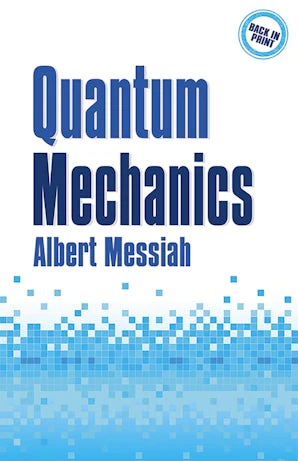
"Strongly recommended" by the American Journal of Physics, this volume serves as a text for advanced undergraduates and graduate students of physics as well as a reference for professionals. Clear in its presentation and scrupulous in its attention to detail, the treatment originally appeared in a two-volume French edition. This convenient single-volume translation begins with formalism and its interpretation, starting with the origins of quantum theory and examinations of matter waves and the Schrödinger equation, one-dimensional quantized systems, the uncertainty relations, and the mathematical framework and physical content of formalism.
The second half opens with an exploration of symmetries and invariance, including a consideration of angular momentum, identical particles and the Pauli exclusion principle, invariance and conservation laws, and time reversal. Methods of approximation include those involving stationary perturbations, the equation of motion, variational method, and collision theory. The final chapters review the elements of relativistic quantum mechanics, and each of the two volumes concludes with useful appendixes.
The second half opens with an exploration of symmetries and invariance, including a consideration of angular momentum, identical particles and the Pauli exclusion principle, invariance and conservation laws, and time reversal. Methods of approximation include those involving stationary perturbations, the equation of motion, variational method, and collision theory. The final chapters review the elements of relativistic quantum mechanics, and each of the two volumes concludes with useful appendixes.
Reprint of the John Wiley & Sons, New York, two-volume 1958 edition.
wave mechanics;quantum theory;wave function;feynman diagrams;modern quantum;classical physics;linear equations;quantum chemistry;classical mechanics;statistical mechanics;understand quantum;quantum field;quantum mechanical;theoretical physics;differential equations;field theory;quantum physics;feynman lectures;subatomic particles;theoretical physicist;neils bohr;conceptual framework;matter physics;condensed matter;mathematical introduction;electronic structure;computational chemistry;matter waves;tensor analysis;vector spaces;differential geometry;differential forms;beginning graduate;functional analysis;hydrogen atom;hidden variables;hilbert space;level undergraduate;tensor calculus;math courses;special functions;self study;angular momentum;mathematical physics;mathematical formalism;physics students;mathematical techniques;leonard susskind;david bohm;linear algebra;advanced undergraduate;mathematical background;advanced mathematics;physical chemistry;undergraduate student;advanced topics;gifted amateur;graduate level;graduate students;serious student;popular science;quantum mechanics;deeper understanding;coddington;symmetries;morin;courant;hatfield;axiomatic;weinberg;morita;zurich;nonlinear;numerical;flanders;dover;riemannian;fock;polynomials;canonical;lagrangian;perturbation;tensors;python;relativity;sakurai;manifolds;invariant;oscillator;schroedinger;hamiltonian;invariance;integrals;marion;shankar;fourier;rigorous;colton;pauling;self-study;matrices;physicists;partialDescription
"Strongly recommended" by the American Journal of Physics, this volume serves as a text for advanced undergraduates and graduate students of physics as well as a reference for professionals. Clear in its presentation and scrupulous in its attention to detail, the treatment originally appeared in a two-volume French edition. This convenient single-volume translation begins with formalism and its interpretation, starting with the origins of quantum theory and examinations of matter waves and the Schrödinger equation, one-dimensional quantized systems, the uncertainty relations, and the mathematical framework and physical content of formalism.
The second half opens with an exploration of symmetries and invariance, including a consideration of angular momentum, identical particles and the Pauli exclusion principle, invariance and conservation laws, and time reversal. Methods of approximation include those involving stationary perturbations, the equation of motion, variational method, and collision theory. The final chapters review the elements of relativistic quantum mechanics, and each of the two volumes concludes with useful appendixes.
The second half opens with an exploration of symmetries and invariance, including a consideration of angular momentum, identical particles and the Pauli exclusion principle, invariance and conservation laws, and time reversal. Methods of approximation include those involving stationary perturbations, the equation of motion, variational method, and collision theory. The final chapters review the elements of relativistic quantum mechanics, and each of the two volumes concludes with useful appendixes.
Reprint of the John Wiley & Sons, New York, two-volume 1958 edition.
wave mechanics;quantum theory;wave function;feynman diagrams;modern quantum;classical physics;linear equations;quantum chemistry;classical mechanics;statistical mechanics;understand quantum;quantum field;quantum mechanical;theoretical physics;differential equations;field theory;quantum physics;feynman lectures;subatomic particles;theoretical physicist;neils bohr;conceptual framework;matter physics;condensed matter;mathematical introduction;electronic structure;computational chemistry;matter waves;tensor analysis;vector spaces;differential geometry;differential forms;beginning graduate;functional analysis;hydrogen atom;hidden variables;hilbert space;level undergraduate;tensor calculus;math courses;special functions;self study;angular momentum;mathematical physics;mathematical formalism;physics students;mathematical techniques;leonard susskind;david bohm;linear algebra;advanced undergraduate;mathematical background;advanced mathematics;physical chemistry;undergraduate student;advanced topics;gifted amateur;graduate level;graduate students;serious student;popular science;quantum mechanics;deeper understanding;coddington;symmetries;morin;courant;hatfield;axiomatic;weinberg;morita;zurich;nonlinear;numerical;flanders;dover;riemannian;fock;polynomials;canonical;lagrangian;perturbation;tensors;python;relativity;sakurai;manifolds;invariant;oscillator;schroedinger;hamiltonian;invariance;integrals;marion;shankar;fourier;rigorous;colton;pauling;self-study;matrices;physicists;partial